If you’ve read The E-Myth Revisited, you know one of the core ideas is to build your business as if it were going to scale, even if you are still small. If you haven’t, the idea is simple: think about the structure your business will need before you actually need it.
That idea is especially important in the commercial janitorial industry, where growth often creates complexity faster than structure can keep up.
Margins are tight. Labor is your largest cost. Customers are price-sensitive. Because of that, many BSCs delay building out their organizational structure, assuming it is something that will come later, once there is more financial room.
The challenge is that growth without structure leads to inconsistency. As the owner takes on more and more responsibility, customer visits become less frequent. Team development slows down. New business development becomes reactive. Without clear roles and ownership, the owner becomes the central point for everything.
A more effective approach is to use your organizational chart as a planning tool.
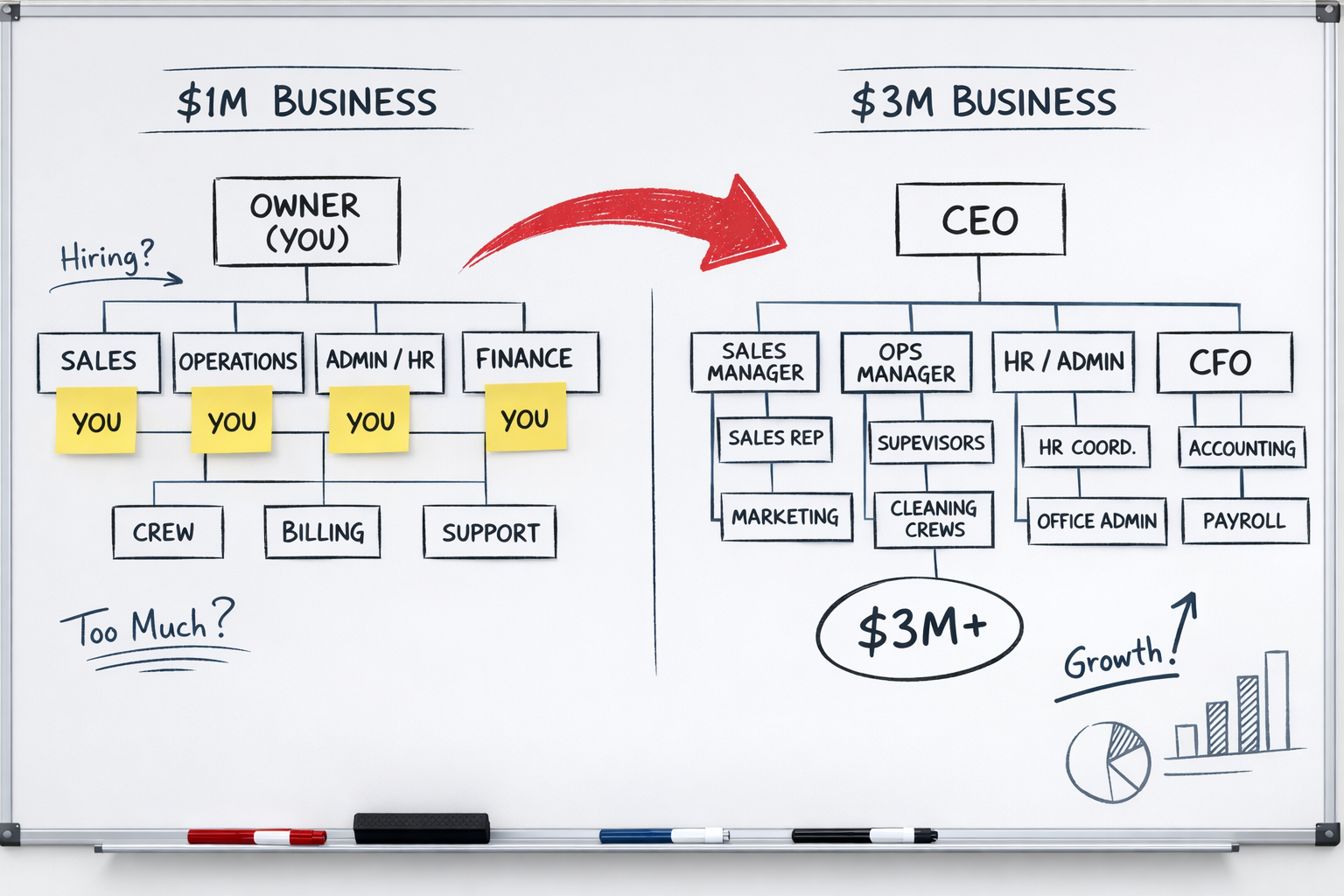
Start by building the full organizational structure on paper, not just for where you are today, but for where you want the business to go next. Ask questions like: what roles would need to exist for this company to operate well at $3 million in annual revenue? What about $5 million or even $10 million?
You should build the full organizational structure on paper now, even if your name is in most of the boxes. You do not need to hire people to fill each role all at once. Instead, it gives you a clear roadmap for what you will need as the business grows.
This is where many BSCs get stuck. They think about people instead of roles. The question becomes, “Who can I hire?” instead of “What needs to exist?”
The roles exist whether or not someone is assigned to them.
In the early stages, the owner is filling most of those roles – leading operations, managing customer relationships, handling hiring, overseeing admin and finance, and trying to drive new business. That works for a period of time, but it eventually creates limitations. The business becomes dependent on one person, and growth slows.
At $5 million to $10 million in annual revenue, the challenge looks different, but the principle is the same. The question is no longer just what roles are needed, but whether the current structure is aligned with the next stage of growth. Are responsibilities clearly defined? Are the right leaders in place? Or has the business outgrown the way it is currently organized?
When you build and revisit your organizational structure, you create a roadmap. You can see which roles you are currently covering, which ones are partially covered, and which ones will need to be developed next. That allows you to be more intentional about how you add capacity and leadership.
A common question is how to know what that structure should look like.
You do not have to figure that out on your own. Talk to other BSC owners who are already at the revenue levels you are working toward. Ask how their business is structured and where they have dedicated leadership. You can also learn from owners in other service industries who are managing similar challenges. What you will find is that, while titles may vary, the core roles are often very similar.
From there, you can apply what you learn to your own business and build a structure that fits your goals.
As your company grows, you will begin to move into that structure. Some roles may start as partial responsibilities before becoming full positions. Some may be supported through outsourcing before they are brought in-house. The important thing is that you are no longer guessing. You are building with intention.
Whether you are at $500,000 or $10 million in annual revenue, the organizational chart gives you a way to step back and think about your business more clearly. It helps you see the roles that need to exist, where your time is going today, and what needs to be built next. When you approach it this way, you are not just reacting to growth. You are planning for it.